How to URL-Encode a String in Python
2026-06-24 · Updated 2026-06-25 · 4 min read
Figure 1: URL-encoding a string in Python
URL (percent) encoding replaces characters that are unsafe in a URL with a % followed by their byte value in hex. A space becomes %20, & becomes %26, and so on. Python handles all of this through the standard urllib.parse module, no installation required.
Try every example in the free Python Executor playground.
quote: encode a single value
Use quote for one piece of text, such as a path segment or a single query value.
from urllib.parse import quote

print(quote("name=AdA & co/path?x=1"))
# name%3DAdA%20%26%20co/path%3Fx%3D1
Notice the / was not encoded. By default quote treats / as safe (handy for paths). To encode everything, pass safe="":
from urllib.parse import quote

print(quote("name=AdA & co/path?x=1", safe=""))
# name%3DAdA%20%26%20co%2Fpath%3Fx%3D1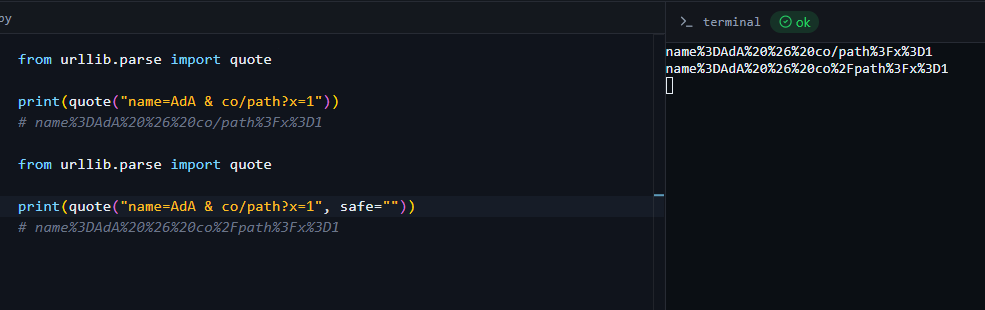
Figure 2: quote() with and without safe="" in the online compiler
quote vs quote_plus
The difference is how they treat spaces. quote turns a space into %20. quote_plus turns it into +, which is what HTML forms use in query strings.
from urllib.parse import quote, quote_plus

print(quote("blue cheese"))       # blue%20cheese
print(quote_plus("blue cheese")) # blue+cheese| Function | Space becomes | Best for |
|---|---|---|
quote |
%20 |
path segments |
quote_plus |
+ |
query-string values |
urlencode: build a whole query string
When you have a dictionary of parameters, urlencode encodes each key and value and joins them with &.
from urllib.parse import urlencode

params = {"q": "blue cheese", "page": 2}
print(urlencode(params))
# q=blue+cheese&page=2

url = "https://example.com/search?" + urlencode(params)
print(url)
# https://example.com/search?q=blue+cheese&page=2
Decode percent-encoded text
unquote reverses quote; unquote_plus also turns + back into a space.
from urllib.parse import unquote, unquote_plus

print(unquote("a%20b%26c%3Dd%2Fe"))   # a b&c=d/e
print(unquote_plus("blue+cheese"))    # blue cheese
Which function should I use?
| Task | Use |
|---|---|
| Encode one path segment | quote |
| Encode one query value | quote_plus |
| Encode a full set of params | urlencode |
Decode %20 style text |
unquote |
Decode + as space |
unquote_plus |
URL-encode online (no code)
For a quick one-off, paste your text into the KeyDecryptor URL Encoder and Decoder and get the result instantly in your browser.
Frequently Asked Questions
What is the difference between quote and quote_plus?
quote encodes a space as %20; quote_plus encodes it as +. Use quote_plus for query-string values and quote for path segments.
Why is / not being encoded?
quote treats / as a safe character by default so it does not break URL paths. Pass safe="" to force every character to be encoded.
How do I encode a whole dictionary of query parameters?
Use urlencode(params). It encodes each key and value and joins them with & into a ready-to-use query string.
Is URL encoding the same as Base64?
No. URL encoding only escapes unsafe characters as %XX; Base64 re-represents raw bytes using a 64-character alphabet. They solve different problems.
Do I need to install urllib?
No. urllib.parse is part of the Python standard library.