
Hashing vs Encryption vs Encoding: Key Differences Explained with Examples
2026-06-07 · 5 min read
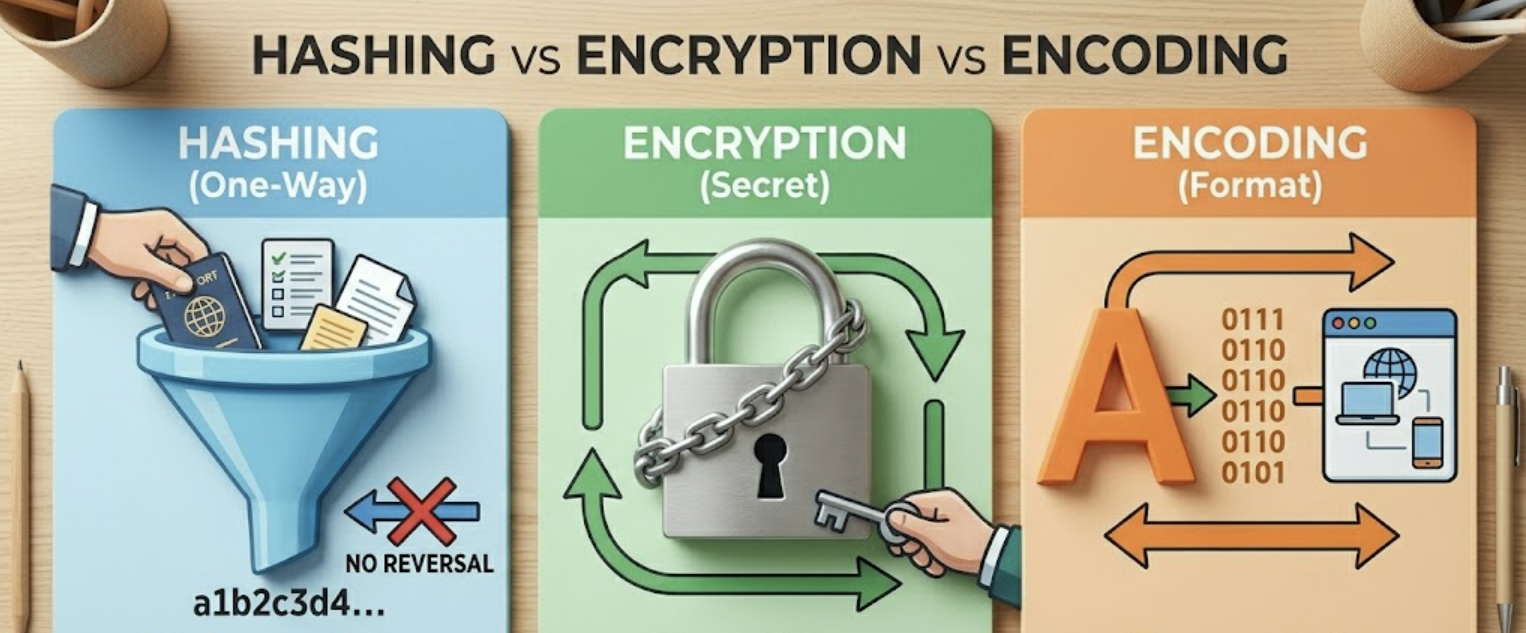
Figure 1: Hashing vs Encryption vs Encoding
Description
Hashing, encryption, and encoding are often confused in cybersecurity and software development. They may look similar because they transform data, but their purpose and behavior are completely different.
Understanding these differences is important for developers, security engineers, and CTF players. It helps in password storage, secure communication, API design, and data handling.
This guide explains hashing vs encryption vs encoding in a simple way with real examples and comparison tables.
What is Encoding?
Encoding is a way to convert data into another format so it can be easily transmitted or stored.
It is not designed for security. Anyone can decode encoded data.
Common encoding examples
- Base64 encoding
- URL encoding
- HTML encoding
- Hex encoding
Example of Base64 encoding
Original text:
helloBase64 encoded:
aGVsbG8=You can easily decode it back. No secret key is required.
Key point
Encoding is not for protection. It is for compatibility.
What is Hashing?
Hashing is a one-way process that converts data into a fixed-length value called a hash.
It is used for integrity checks and password storage.
Common hashing algorithms
- MD5
- SHA-1
- SHA-256
- bcrypt
- Argon2
Example of hashing
Input:
password123SHA-256 output:
ef92b778bafee...You cannot reverse a hash back to the original input.
Where hashing is used
- Password storage
- File integrity checks
- Digital signatures
- Blockchain systems
Key point
Hashing is one-way and cannot be reversed.
What is Encryption?
Encryption is a two-way process that protects data using a key.
Only someone with the correct key can decrypt it.
Common encryption types
- AES
- RSA
- DES
- ChaCha20
Example of encryption
Original:
helloEncrypted output:
U2FsdGVkX1+9k3...Decrypted back (with key):
helloWhere encryption is used
- HTTPS websites
- Messaging apps
- File protection
- VPN services
Key point
Encryption is reversible with the correct key.
Hashing vs Encryption vs Encoding: Key Differences
| Feature | Encoding | Hashing | Encryption |
|---|---|---|---|
| Purpose | Data format conversion | Data integrity and password storage | Data protection and confidentiality |
| Reversible | Yes | No | Yes (with key) |
| Key required | No | No | Yes |
| Output length | Variable | Fixed | Variable |
| Security level | None | Medium to high | High |
| Example use | Base64, URL encoding | SHA-256, bcrypt | AES, RSA |
Real-World Examples
Example 1: Website login
- Password is hashed (not encrypted)
- Server compares hash values
- Original password is never stored
Example 2: HTTPS connection
- Data is encrypted using TLS
- Only browser and server can decrypt it
Example 3: API data transfer
- Data may be encoded (Base64)
- Encoding ensures safe transport, not security
Common Confusions Explained
Is Base64 encryption?
No. Base64 is encoding, not encryption.
Can hashes be decrypted?
No. Hashing is one-way. It can only be cracked using brute force or lookup tables.
Is encryption the same as hashing?
No. Encryption can be reversed. Hashing cannot.
When to Use Each One
Use Encoding when:
- Sending data over URLs
- Storing binary data in text format
- Ensuring compatibility
Use Hashing when:
- Storing passwords
- Verifying file integrity
- Detecting data changes
Use Encryption when:
- Protecting sensitive data
- Secure communication
- Storing confidential files
Simple Memory Trick
- Encoding = formatting
- Hashing = fingerprint
- Encryption = locked box
Final Thoughts
Encoding, hashing, and encryption all transform data, but they solve completely different problems.
If you are a developer or security learner, understanding these differences is essential for building secure systems and analyzing real-world vulnerabilities.
For practical use, encoding helps with data formatting, hashing ensures integrity, and encryption protects confidentiality.