CyberChef vs KeyDecryptor: Which Tool Should You Use?
2026-05-24 · 4 min read
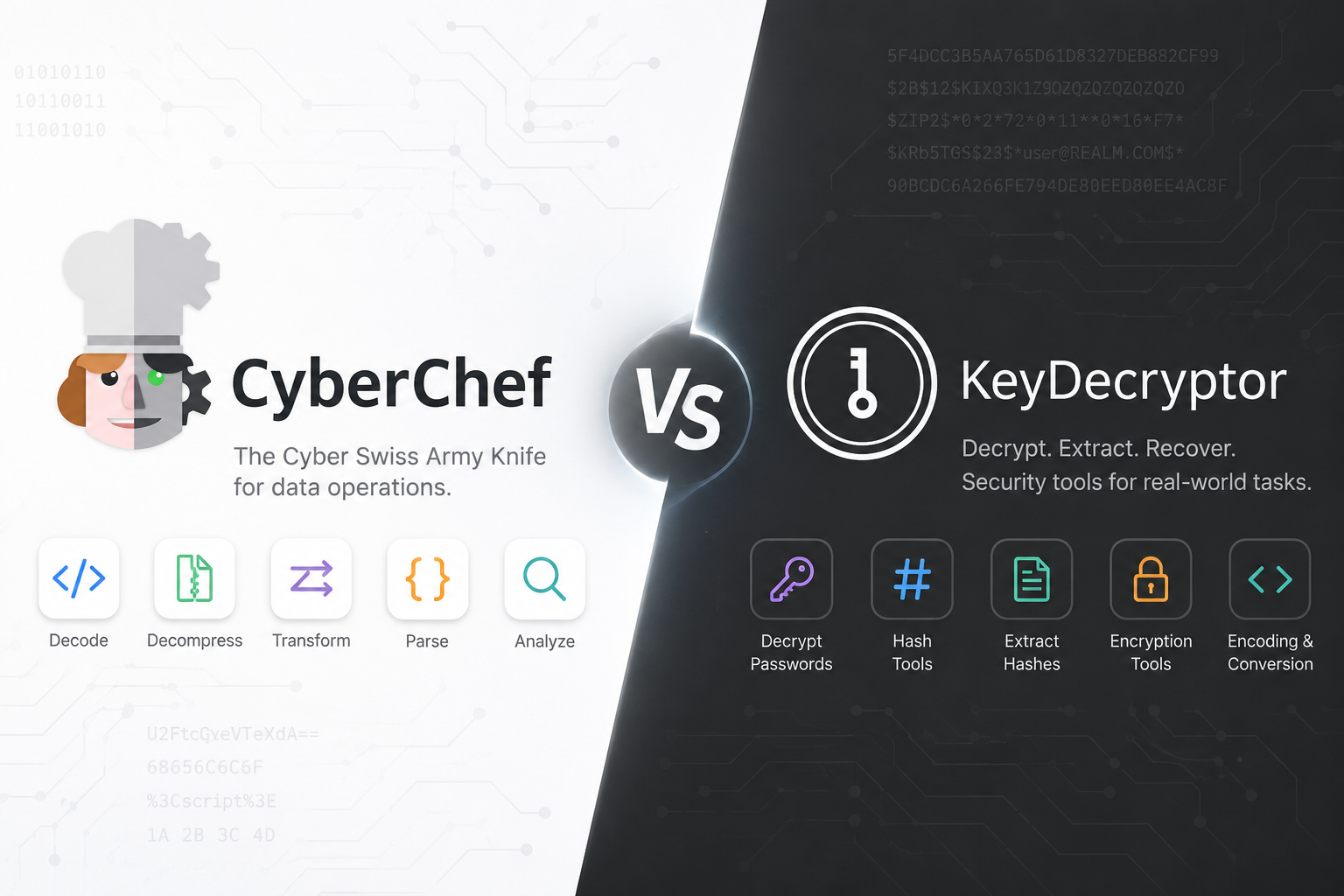
Figure 1: CyberChef vs KeyDecryptor
Description
CyberChef and KeyDecryptor are both useful tools for security learners, developers, analysts, and CTF players. However, they are built for different workflows.
CyberChef is a powerful data transformation tool. It is great for decoding, encoding, compressing, decompressing, parsing, and chaining multiple operations together.
KeyDecryptor is focused on practical security utilities. It provides password decryptors, hash tools, hash extractors, encryption helpers, encoding tools, and file conversion utilities in a simple tool-based interface.
This guide explains the difference between CyberChef and KeyDecryptor, where each tool works best, and when you should use one over the other.
What is CyberChef?
CyberChef is a web-based tool created by GCHQ for analyzing and transforming data. It uses a recipe-based workflow where you drag operations into a chain and apply them to your input.
It is commonly used for:
- Base64 decoding
- URL decoding
- Hex conversion
- Gzip and zlib decompression
- XOR operations
- JSON formatting
- Text extraction
- Data cleanup
- Malware and CTF payload analysis
CyberChef is extremely flexible because you can combine many operations together.
For example, you can take a suspicious payload, decode it from Base64, gunzip it, XOR it with a key, and then format the output as JSON in one recipe.
What is KeyDecryptor?
KeyDecryptor is a focused collection of online security tools for password recovery, hash analysis, decryption, encoding, and file conversion.
It is designed for users who want to open a specific tool, paste the input, and get the result without building a recipe manually.
It is commonly used for:
- Decoding stored passwords
- Identifying hash types
- Generating hashes
- Extracting John-compatible hashes
- Working with Base64, URL encoding, and HTML entities
- Decrypting supported application password formats
- Converting developer and security data formats
- Handling CTF and lab-based password recovery tasks
If you already know the format, KeyDecryptor is often faster because each tool is purpose-built.
CyberChef vs KeyDecryptor: Main Difference
CyberChef is best when you need flexible data transformation.
KeyDecryptor is best when you need a direct security tool for a known task.
| Feature | CyberChef | KeyDecryptor |
|---|---|---|
| Main purpose | General data transformation | Security-focused tools |
| Workflow | Recipe-based | Tool-based |
| Best for | Chained decoding and analysis | Password recovery, hash tools, and specific decryptors |
| Learning curve | Medium | Low |
| Hash generation | Supported | Supported |
| Hash identification | Possible with manual analysis | Dedicated tool |
| Password decryptors | Limited | Focused decryptor tools |
| File hash extraction | Not the main focus | Dedicated extraction utilities |
| CTF usage | Very useful | Very useful |
| Best user | Analyst who needs flexible operations | User who knows the target format |
When Should You Use CyberChef?
Use CyberChef when the input needs multiple transformations before it becomes readable.
Good examples include:
- A Base64 string that contains compressed data
- A payload that needs XOR decoding
- A log entry with mixed encodings
- Malware configuration data
- A CTF challenge with several encoding layers
- Data that needs several cleanup steps
CyberChef is also useful when you are not sure what the input is and want to test different operations quickly.
When Should You Use KeyDecryptor?
Use KeyDecryptor when you already know the type of data or the tool you need.
Good examples include:
- Decode a VNC stored password
- Decode a Cisco Type 7 password
- Recover a GPP cpassword value
- Identify a hash type
- Generate MD5, SHA, NTLM, or bcrypt hashes
- Extract hashes from ZIP, SSH, Office, or PDF files
- Convert Base64, URL encoded text, or HTML entities
- Format JSON, XML, YAML, or Markdown
KeyDecryptor is better when you want a direct answer from a specific tool.
Example Workflow: Hash Identification
Suppose you find this value during a CTF or internal audit:
5f4dcc3b5aa765d61d8327deb882cf99In CyberChef, you can inspect the length and test possible hash operations manually.
In KeyDecryptor, you can use the Hash Identifier tool and get possible matches such as MD5, NTLM, or MD4 based on the hash length and character pattern.
This does not always prove the exact algorithm, because multiple hashes can share the same format. However, it quickly narrows down the options and helps you choose the next step.
Example Workflow: Stored Password Decoding
Suppose you have a stored password from a supported application or network device.
In CyberChef, you may need to know the exact algorithm, key, mode, padding, and format before building a working recipe.
In KeyDecryptor, you can open the matching decryptor, paste the encrypted value, and decode it directly if the format is supported.
This makes KeyDecryptor useful for quick password recovery tasks, especially during authorized audits, labs, and CTF practice.
Is KeyDecryptor a CyberChef Alternative?
KeyDecryptor is not a full replacement for CyberChef.
CyberChef is still better for advanced data transformation and chained analysis.
KeyDecryptor is better for focused security tasks where users need a dedicated tool instead of manually building a recipe.
A good practical approach is:
- Use CyberChef when the data is unknown or heavily encoded.
- Use KeyDecryptor when you know the password format, hash format, or target utility.
- Use both together during CTFs, security labs, and investigation workflows.
Which One is Better?
There is no single winner.
CyberChef is better for flexible analysis.
KeyDecryptor is better for direct password recovery, hash utilities, and purpose-built security tools.
If you work with encoded payloads, logs, malware strings, or layered transformations, CyberChef should be in your toolkit.
If you work with stored passwords, hash extraction, hash identification, encoding utilities, and security-specific converters, KeyDecryptor can save time.
Final Thoughts
CyberChef and KeyDecryptor solve different problems.
CyberChef gives you a powerful recipe engine for transforming almost any kind of data.
KeyDecryptor gives you a focused set of security tools for password recovery, hash analysis, encoding, encryption, and file conversion workflows.
For the best results, use both. CyberChef helps you understand and transform unknown data. KeyDecryptor helps you quickly complete known security tasks with dedicated tools.